

Do Printer Heads Go Out On Thermal Cash Registers

A receipt printed on thermal paper. A heat source nigh the paper will color the newspaper.
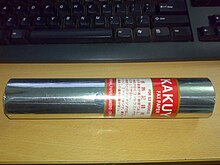
Paper coil for thermal fax machine.
Thermal paper (sometimes referred to equally an audit coil) is a special fine paper that is coated with a material formulated to alter colour when exposed to estrus. It is used in thermal printers, particularly in inexpensive or lightweight devices such as calculation machines, cash registers, and credit card terminals.
The surface of the paper is coated with a solid-state mixture of dye and a suitable matrix; a combination of a fluoran leuco dye for example. When the matrix is heated in a higher place its melting point, the dye reacts with the acid, shifts to its colored form, and the inverse form is then conserved in a metastable state when the matrix solidifies back quickly plenty. The reactant acid in thermal newspaper is ofttimes bisphenol A (BPA).
Unremarkably, the coating will turn black when heated, only coatings that turn blue or red are sometimes used. While an open heat source, such equally a flame, can discolor the paper, a fingernail swiped quickly across the paper will often generate enough heat from friction to produce a mark.
Multicolor thermal paper get-go became bachelor in 1993 with the introduction of the Fuji Thermo-Autochrome (TA) system.[i] This was followed in 2007 past Polaroid's development of the Zink ("zilch-ink") system.[2] Both of these methods rely on multi-layer coatings with three split colorizing layers, with different methods used for contained activation of each layer.
History [edit]
The earliest direct thermal papers were developed past NCR Corporation (using dye chemistry) and 3M (using metal salts). The NCR technology became the marketplace leader over time, although the image would fade rather quickly compared with the much more than expensive, merely durable 3M technology.
Texas Instruments invented the thermal print head in 1965, and the Silent 700, a estimator terminal with a thermal printer, was released in the market in 1969. The Silent 700 was the first thermal print system that printed on thermal paper. During the 1970s, Hewlett-Packard integrated thermal paper printers into the design of its HP9800 serial desktop computers, and integrated it into the top of the 2600-series CRT terminals also equally in plotters.
In the 1970s and early 1980s, Japanese producers (such every bit Ricoh, Jujo, and Kanzaki), using similar dye-based chemistry, formed partnerships with barcode printer manufacturers (such every bit TEC, Sato, and others) and entered the emerging global bar code industry, primarily in supermarkets. U.South. producers such as Appleton (NCR's licensee), Nashua Corporation, Graphic Controls, and others fought to gain marketplace share. Leading pressure level-sensitive label producers such equally Avery Dennison became major consumers of direct thermal newspaper for label applications.
In the late 1980s and early on 1990s, thermal transfer, laser printing, electrophotography, and, to a lesser extent, ink jet printing began to take away industrial and warehouse barcode applications due to better immovability. Direct thermal made a potent comeback with point of sale receipts (gasoline pumps, cash registers, rental car receipts, etc.).
During 1998, Nintendo used thermal paper technology for their Game Boy Printer.
In 2006, NCR Corporation's Systemedia division introduced two-sided thermal press engineering, chosen "2ST".
Chemistry [edit]
Four dissimilar types of imaging chemicals are used in thermally sensitive papers: leuco dyes, developers, sensitizers and stabilizers.[3]
- Leuco dyes
- The leuco dyes used in straight thermal paper are usually triaryl methane phthalide dyes , such every bit Yamamoto Blueish 4450, or fluoran dyes, such as Pergascript Black 2C. A third widely used leuco dye is Crystal violet lactone. Blood-red or magenta colour can be achieved with dyes such equally Yamamoto Red twoscore. Yellow tin can exist produced by the protonation of a triaryl pyridine, such as Copikem Yellow 37. These dyes accept a colorless leuco grade when crystalline or when in a pH neutral surroundings, just become colored when dissolved in a melt and exposed to an acidic environment.
- Developers
- Leuco dyes, in full general, provide little color when melted unless they are melted in conjunction with ane or more organic acids. Examples of organic acids suitable for thermochromic papers are phenols such every bit Bisphenol A (BPA) and Bisphenol Due south (BPS). Other suitable acidic materials are sulfonyl ureas such as BTUM and Pergafast 201. Zinc salts of substituted salicylic acids, such equally zinc di-tert-butylsalicylate have too been commercially used as developers .
- Sensitizers
- A leuco dye and a programmer, when melted together, are enough to produce color. However, the thermal threshold of the coated layer containing the colorizing components is determined by the lowest melting component of the layer. Furthermore, developers and leuco dyes often mix poorly upon melting. To optimize the colorization temperature and to facilitate mixing, a third chemical called a sensitizer is unremarkably added to the imaging layer. Sensitizers are ordinarily simple ether molecules such as ane,2-bis-(3-methylphenoxy)ethane or 2-benzyloxynapthalene. These 2 materials melt at approximately 100°C, which is a practical lower limit for thermal coloration. These low-cost ethers are excellent low viscosity solvents for leuco dyes and developers, and this facilitates color germination at a well-defined temperature and with minimum energy input.
- Stabilizers
- Dyes in thermally sensitive newspaper are often unstable and return to their original colorless, crystalline forms when stored in hot or humid conditions.[iv] To stabilize the metastable glass formed past the leuco dye, developer and sensitizer, a 4th type of material called a stabilizer is oftentimes added to thermal papers. Stabilizers ofttimes share similarities with developers and are oft complex multifunctional phenols that inhibit recrystallization of the dye and programmer, thereby stabilizing the printed image.
Multicolored papers [edit]
In the early 2000s, Polaroid adult the Zink "zero-ink" engineering science.[five] The newspaper is used in compact photograph printers. It has several layers: a backing layer with optional force per unit area sensitive adhesive, heat-sensitive layers with cyan, magenta and yellow pigments in colorless form, and overcoat. Zink technology allows the press of total-color images in a unmarried pass without requiring ink cartridges. The color addressing is achieved past controlling the estrus pulse length and intensity.[6] The color-forming layers contain colorless crystals of amorphochromic dyes. These dyes form microcrystals of their colorless tautomers, which convert to the colored form by melting and retain color subsequently resolidification.[7] The xanthous layer is the topmost one, sensitive to short heat pulses of high temperature. The magenta layer is in the middle, sensitive to longer pulses of moderate temperature. The cyan layer is at the bottom, sensitive to long pulses of depression temperature. The layers are separated by thin interlayers, acting as heat insulation, moderating the heat throughput.[8]
Protective coating [edit]
Almost direct thermal papers require a protective top-coating to:
- reduce fading of the thermal paradigm caused by exposure to UV light, water, oils, grease, lard, fats, plasticizers, and like causes
- reduce impress head wearable
- reduce or eliminate residue from the thermal coating on the thermal print heads
- provide better anchorage of flexographic printing inks practical to the thermal paper
- focus the heat from the thermal print head on the active blanket.
Wellness and environmental concerns [edit]
Some thermal papers are coated with BPA, a chemical considered to be an endocrine disruptor.[9] [10] This material can contaminate recycled paper.[11] [12] BPA tin can transfer readily to the pare in small amounts:
When taking concur of a receipt consisting of thermal printing newspaper for five seconds, roughly 1 μg BPA (0.2–0.6 μg) was transferred to the forefinger and the middle finger if the skin was rather dry, and about 10 times more than than this if these fingers were wet or very greasy. Exposure to a person who repeatedly touches thermal printer paper for most ten hours per solar day, such as at a cash register, could reach 71 micrograms per day, which is 42 times less than the nowadays tolerable daily intake (TDI).[13]
The chemical bisphenol A (BPA) is used for thermal newspaper coatings because of its stability and oestrus-resistance. This allows inkless printing for receipts from cash registers. People who often are in contact with BPA coated receipts practise have a college level of BPA in their bodies than people with boilerplate contact. Therefore, the New York Suffolk County signed a resolution to ban BPA in thermal receipt papers. Violation of this new police force, the "Safer Sales Slip Human action", involves a U.s.a.$500 penalty. The law became effective beginning January three, 2014.[14]
Recently, bisphenol Due south (BPS), an analog of BPA that has been shown to have similar in vitro estrogenic activeness to BPA,[xv] [16] has been used in thermal paper coatings. The recycling of thermal paper coated with BPS can introduce BPS into the cycle of paper product and cause BPS contamination of other types of paper products.[12]
Newer formulations can be purchased which are "phenol complimentary" and use either urea based compounds or vitamin-c.[17] [18] The phenol free variants such as urea based tin can accept comparable or even improved print quality, however it can toll more.
References [edit]
- ^ U. S. Patent 5,216,438, Direct color thermal printing method for optically and thermally recording a total-color epitome on a thermosensitive recording medium, past S. Nakao, N. Katsuma and A. Nagata, Fuji Photo Moving picture Co. (1993)U.S. Patent 5,216,438
- ^ U. S. Patent vii,166,558, Thermal imaging system, Bhatt et al., (2007) U.S. Patent 7,166,558
- ^ Chemical science and Applications of Leuco Dyes, ed. Ramaiah Muthyala, Plenum Press, New York, pp. 125-203 (1997)
- ^ "How to properly store thermal newspaper". xxx January 2017.
- ^ U. Southward. Patent 7,166,558, Thermal imaging system, Bhatt et al., (2007).
- ^ "How Ink-gratis Mobile Photo Printers Work". howstuffworks.com. 24 June 2008.
- ^ Peter Bamfield; Michael G. Hutchings (2010). Chromic Phenomena: Technological Applications of Colour Chemistry. Royal Society of Chemical science. p. 114. ISBN978-i-84755-868-8.
- ^ "THERMAL IMAGING SYSTEM". freepatentsonline.com.
- ^ Babu, Due south., Uppu, South. N., Martin, B., Agu, O. A., & Uppu, R. M. (2015). "Unusually high levels of bisphenol A (BPA) in thermal paper cash register receipts (CRs): development and application of a robust LC-UV method to quantify BPA in CRs". Toxicology Mechanisms and Methods. 25 (5): 410–half-dozen. doi:ten.3109/15376516.2015.1045661. PMID 26024012. S2CID 20335285.
{{cite periodical}}: CS1 maint: multiple names: authors listing (link) - ^ Liao C, Kannan K (August 2011). "High levels of bisphenol A in newspaper currencies from several countries, and implications for dermal exposure". Environ. Sci. Technol. 45 (sixteen): 6761–eight. Bibcode:2011EnST...45.6761L. doi:x.1021/es200977t. PMID 21744851.
- ^ Fukazawa h, H. Thou.; Hoshino, K.; Shiozawa, T.; Matsushita, H.; Terao, Y. (2001). "Identification and quantification of chlorinated bisphenol a in wastewater from wastepaper recycling plants". Chemosphere. 44 (five): 973–979. Bibcode:2001Chmsp..44..973F. doi:10.1016/S0045-6535(00)00507-five. PMID 11513431.
- ^ a b Pivnenko, Kostyantyn; Pedersen, G.A.; Eriksson, Eastward.; Astrup, T.F. (2015). "Bisphenol A and its structural analogues in household waste paper" (PDF). Waste product Management. 44: 39–47. doi:10.1016/j.wasman.2015.07.017. PMID 26194879.
- ^ Biedermann, Sandra; Tschudin, Patrik; Grob, Koni (September 2010). "Transfer of bisphenol A from thermal printer newspaper to the pare". Analytical and Bioanalytical Chemistry. 398 (1): 571–576. doi:ten.1007/s00216-010-3936-9. PMID 20623271. S2CID 7412010.
- ^ "BPA Cash Register Roll Ban Enforced In Suffolk County". Retrieved 6 December 2015.
- ^ Viñas, R.; Watson, C. S. (2013). "Bisphenol S Disrupts Estradiol-Induced Nongenomic Signaling in a Rat Pituitary Prison cell Line: Effects on Jail cell Functions". Environmental Health Perspectives. 121 (3): 352–8. doi:10.1289/ehp.1205826. PMC3621186. PMID 23458715.
- ^ Ji, K.; Hong, South.; Kho, Y.; Choi, Thousand. (2013). "Effects of Bisphenol South Exposure on Endocrine Functions and Reproduction of Zebrafish". Environmental Science & Technology. 47 (15): 8793–8800. Bibcode:2013EnST...47.8793J. doi:x.1021/es400329t. PMID 23806087.
- ^ "Phenol Costless Thermal Paper Rolls". thermalroll.com. half dozen Jan 2022.
- ^ "The Surprising Benefits and Pitfalls of BPA-Free Thermal Newspaper Rolls". paperrollproducts.com. 31 May 2017.
External links [edit]
- Texas Instruments-Computers & Software and Industrial Controls
- Silent 700 Electronic Information Terminals, 1976(PDF)
- 2ST 2-Sided Thermal Printing National Cash Annals

Do Printer Heads Go Out On Thermal Cash Registers,
Source: https://en.wikipedia.org/wiki/Thermal_paper
Posted by: smithidely1938.blogspot.com
0 Response to "Do Printer Heads Go Out On Thermal Cash Registers"
Post a Comment